Watch List Management in Middle-Market Lending
Rigorous watch list discipline catches problem loans before they become losses.

A watch list only works if the discipline behind it is strict enough to catch trouble before it becomes a loss. In middle-market lending, that discipline hinges on four things: what gets a loan onto the list, how deeply it gets reviewed once it's there, how fast that review escalates as conditions worsen, and how clearly the findings travel up to management and the board. Get any one of those wrong, and the watch list turns from an early warning system into a document that just confirms what everyone already suspected.
The regulatory backbone for this is the Interagency Guidance on Credit Risk Review Systems, SR letter 20-13, which treats the prompt identification of higher-risk loans as a core element of a sound credit risk rating framework. That guidance lays out why internal risk ratings exist in the first place: to catch loans with well-defined weaknesses early enough to limit losses, to give the institution a defensible basis for its allowance for loan and lease losses, to surface trends and problem pockets across the portfolio, to check whether lending staff are actually following policy, and to hand the board an honest read on loan quality. None of that happens automatically. Watch list grades sit alongside the formal regulatory categories, special mention, substandard, doubtful, rather than replacing them. Regulators define the threshold for special mention, but they leave the pass grades and the internal watch grade structure entirely to the institution's judgment. That absence of a prescribed format is why watch list design varies so much from one shop to the next, and why some lists catch deterioration early while others just log it after the fact.
What makes middle-market lending a distinct monitoring environment
Broadly syndicated loans and core middle-market direct lending are often discussed as if they're the same asset class wearing different clothes. Broadly syndicated loans and core middle-market direct lending are not the same asset class wearing different clothes. The underwriting standards, the documentation practices, and the degree of lender oversight differ enough that surveillance habits built for one are a poor template for the other.
Core middle-market borrowers occupy an odd structural position. They're large enough to have real operating history and enough scale to generate meaningful financial data, but they're generally not large enough to tap liquid capital markets as an alternative source of financing. That gives direct lenders something broadly syndicated lenders often don't have: time. Time to do real diligence, and enough leverage in the negotiation to actually shape the loan documentation rather than accept take-it-or-leave-it terms.
That structural advantage cuts two ways, though. Tighter, often bilateral or club-style lending relationships mean direct access to the borrower and its management team, which sounds like an obvious edge. But direct access only helps if it's used systematically; otherwise it breeds a kind of complacency, the sense that "we'd know if something was wrong" substituting for an actual review cadence. Covenant protection works the same way. In theory, tighter covenants give lenders an early contractual tripwire. In practice, covenant erosion is a live and growing concern, one this piece returns to later.
Layer onto that an opacity problem specific to private credit: only around 20% of private credit issuers carry a public rating. For the large majority who remain unrated, the lender's own internal risk assessment is often the only formal credit opinion that exists anywhere. There's no rating agency second opinion to lean on, no market price to sanity-check against. The watch list, in a very real sense, is the only credit research the institution has.
The criteria that determine which loans belong on the watch list
Early Warning Systems are supposed to be the front end of this process, built with trigger levels calibrated to the institution's own credit risk appetite, strategy, and policy, so that specific predefined actions, including watch list placement, fire before deterioration turns into an actual loss. The design only works if the triggers are the right ones.
A sound set of triggers blends qualitative judgment with hard quantitative signals. The EY framework on early warning design includes a deteriorating client credit risk profile on the qualitative side. On the quantitative side, several signals matter more than others. Delinquency migration, meaning movement through the 30, 60, and 90-plus day past-due buckets, is the most obvious. Risk rating downgrades or adverse migration in the rating history matter just as much, since a credit sliding two notches in two quarters tells a different story than one holding steady at a weaker grade. Negative free cash flow trends belong on the list. So does any covenant breach or waiver request. Sector-specific stress flags round it out, and those get their own treatment further down.
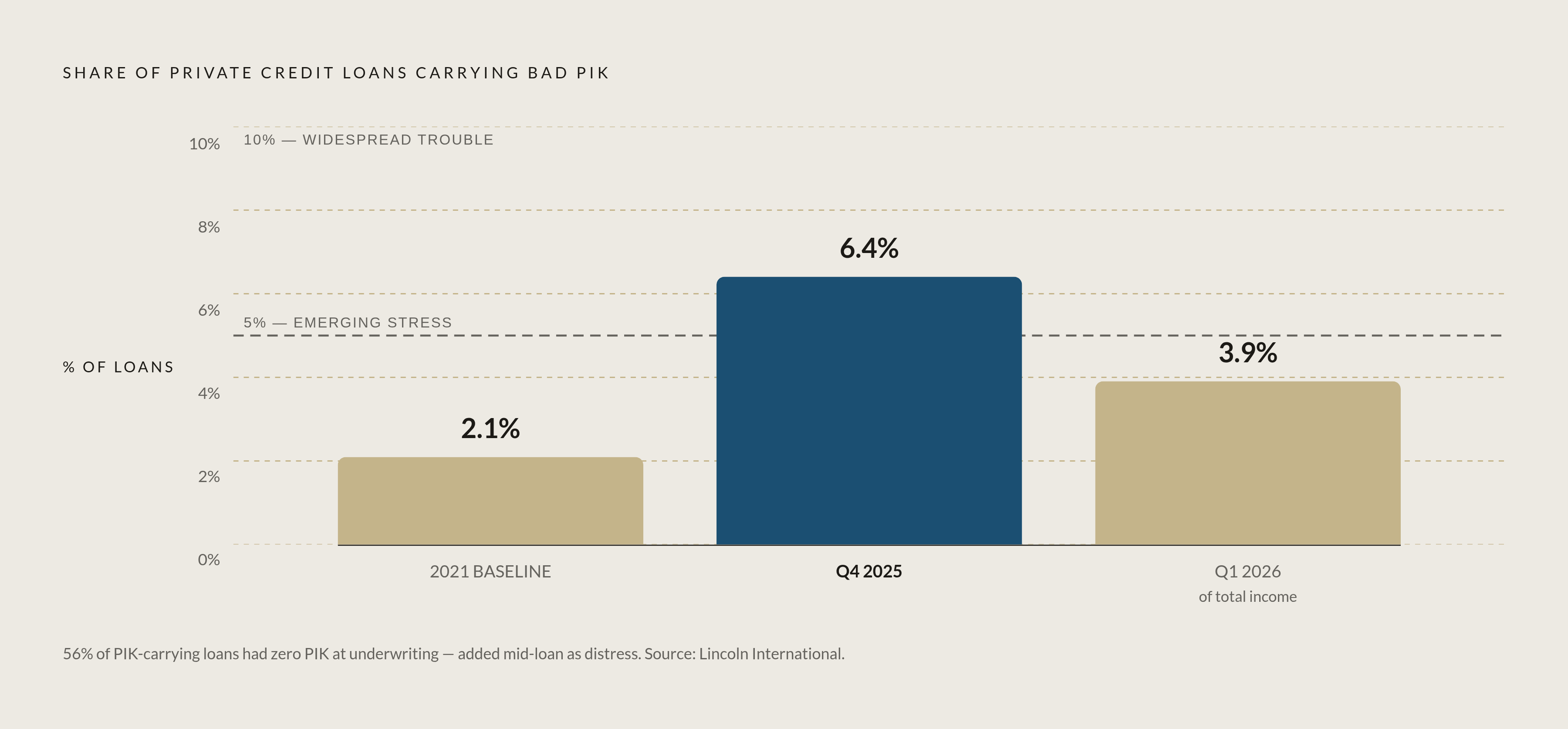
PIK interest deserves special attention as a trigger, and the current data explains why. Lincoln International's valuation data showed 11% of the investments it covers carrying some PIK interest. Of that group, 56% had no PIK at underwriting at all; the payment-in-kind feature was added mid-loan, as a direct response to borrower stress. That works out to roughly 6% of Lincoln's entire valuation universe showing this pattern: a loan that started as a cash-pay credit and quietly became something else. Call it a shadow default. It doesn't touch headline default statistics because no payment was actually missed, but a credit whose lender agreed to defer cash interest because the borrower couldn't generate enough cash to pay it is a credit in trouble, full stop. If that loan isn't on the watch list, the watch list has already failed at its one job. That said, not all PIK is a red flag: some deals are structured with PIK toggle features at origination as a deliberate, negotiated part of the capital structure. Entry criteria need to distinguish between PIK arranged as a structuring choice at underwriting and PIK added mid-loan as a distress signal.
Free cash flow deserves the same weight. The IMF's 2025 Financial Stability Report found that roughly 40% of private credit borrowers now run negative free cash flow. That's a substantial share of the borrower base operating in a cash-burn position, and a watch list without an explicit FCF screen is simply blind to a large and growing population of structurally stressed credits.
What the watch list should contain and how it should be structured
A watch list entry is only useful if it contains enough information for someone who wasn't in the room to understand why the credit is there and what happens next. At minimum, that means the borrower's name and outstanding exposure, the current risk rating alongside the date it entered the watch list, a stated reason for placement (not a vague note, an actual articulated weakness), a recommended action plan, and the date of the last review.
Risk rating history matters as much as the current grade. A minimum of two quarters of migration history, and ideally four, lets an analyst tell whether a credit is genuinely improving toward removal from the list or sliding toward special mention or an outright classified status. Without that history, every watch list entry looks the same: static, present-tense, uninformative about direction.
At the portfolio level, the watch list should feed a handful of specific analytics rather than sit as an isolated document. A risk rating migration matrix, comparing beginning-of-period and end-of-period grades, is the single most useful tool here. Alongside it: a weighted-average risk rating for the total portfolio and for major segments, criticized and classified asset ratios tracked against internal policy thresholds, delinquency buckets at 30, 60, and 90-plus days, and nonaccrual and troubled debt restructuring data. For institutions running large, complex portfolios, regulators expect historical loss experience to be tracked by risk-rating category, and the migration matrix is the instrument that actually makes that tractable. Without it, "historical loss experience by rating category" is just a phrase in an exam manual rather than something anyone can produce on demand.
Scaling monitoring frequency and depth with risk severity
Real-time data feeds and analytics, whether built on one model or otherwise, are designed to speed up detection of creditworthiness problems, according to EY's framework on early warning systems. That's the theory. In practice, the output of any analytical engine is only as good as the review process sitting behind it. A trigger that fires into an inbox nobody checks weekly isn't an early warning system, it's a log file.
Monitoring depth needs to scale with how bad things actually are, not stay flat across the whole watch list. A standard watch credit, one flagged for a modest concern, probably warrants periodic financial statement review, a covenant compliance certification, and scheduled dialogue with the sponsor or management team. A credit that's elevated, approaching special mention territory, needs more: more frequent financial updates, an independent look at collateral, direct contact with the borrower rather than routing everything through the sponsor, and an honest assessment of how much liquidity runway remains. Credits carrying a PIK amendment, a covenant waiver, or negative free cash flow belong in a third tier entirely, one with a heightened review cadence tied to specific milestones. The action plan for that tier should read like a conditional timeline with dates and triggers attached, a departure from a generic quarterly review cycle repeated by habit.
The reason this scaling matters so much in direct lending specifically comes down to a basic information asymmetry. Valuations in private credit are often conducted less frequently than in public markets and can involve considerable discretion on the part of the valuation agent or the lender itself. There's no market price ticking in real time to serve as a cross-check. Internal monitoring has to substitute for what mark-to-market pricing would otherwise reveal. The review cadence isn't just a compliance exercise; it's doing the job that price discovery does in liquid markets.
Covenants are supposed to be the backstop here, and for now, they mostly still are. Roughly 70% of private credit issuance is not covenant-lite, so most deals in the market still carry maintenance covenants that force a periodic compliance test regardless of anything else. But competitive pressure for mandates is pushing cov-lite structures further into the middle market than they used to reach, and where covenants have been waived, loosened, or were never there to begin with, the monitoring protocol has to compensate with more frequent qualitative check-ins. Covenant compliance testing is a floor, not a ceiling. Where the floor is missing, the review process has to work harder to make up the difference.
Which sectors currently generate the most watch list candidates
Sector matters, and the current data points to a few clear clusters of concentrated stress.
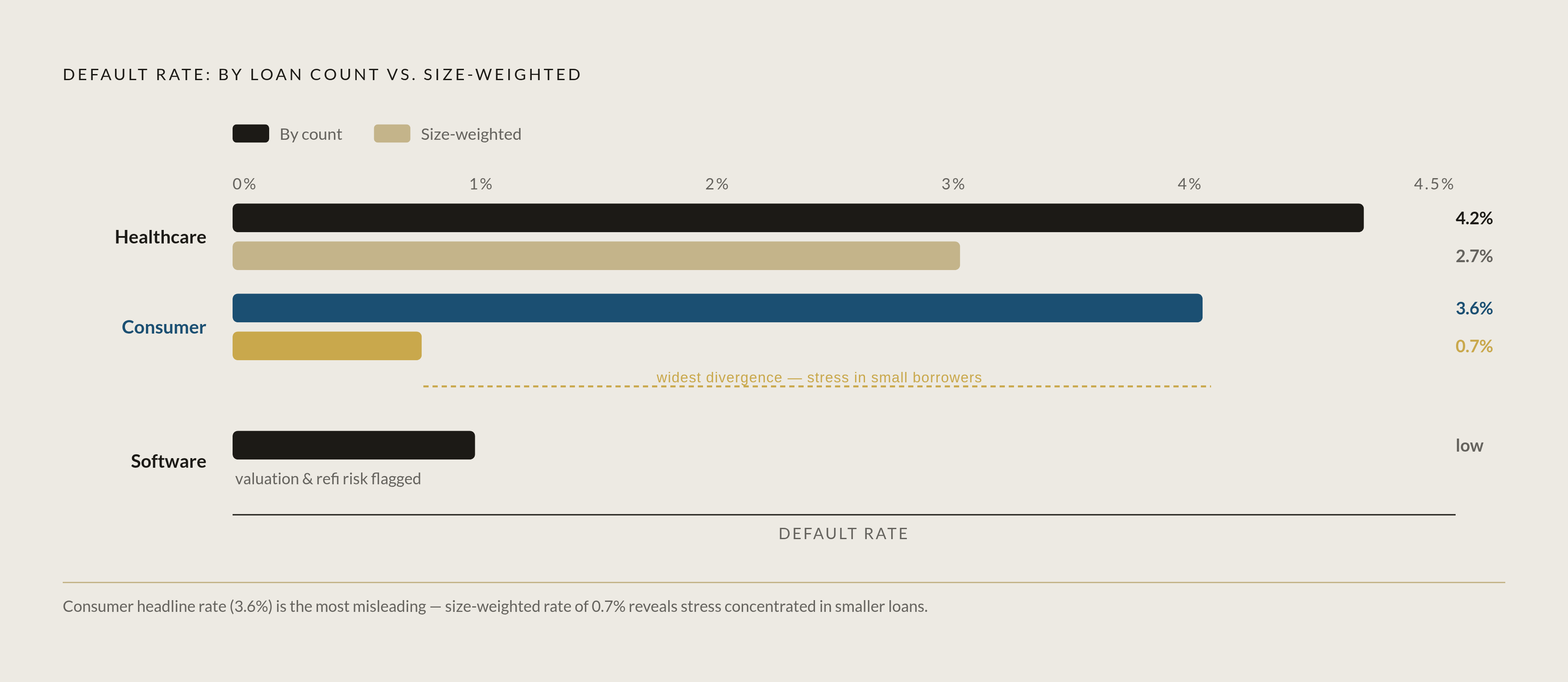
Healthcare stands out as the only sector showing elevated defaults on both a count basis and a size-weighted basis, at 4.2% and 2.7% respectively, in a dataset covering more than 60,000 loan valuations that launched in November 2025. FTI Consulting's Leveraged Loan Market Survey, conducted in November–December 2025, identified healthcare among sectors most likely to see distress in 2026. Morgan Stanley has flagged healthcare as a sector warranting caution heading into 2026, consistent with the elevated default rates the sector's data reflects. Given that track record, there's a reasonable case for placing healthcare credits under automatic elevated monitoring rather than waiting for a borrower-specific trigger to fire.
Consumer and retail present a more complicated picture. FTI Consulting's 2026 survey identified Retail & Consumer Products and Restaurants and Dining among sectors most likely to see distress. Consumer sector defaults are 3.6% by count but only 0.7% weighted by size. That gap is the real story: it means stress is concentrated heavily among smaller borrowers rather than spread evenly across the sector. Portfolios with smaller average ticket sizes in consumer lending should expect the watch list population in that sector to keep growing, even while the size-weighted headline number looks tame.
Software and technology tell yet another version of the story. Software borrowers post among the lowest default rates of any industry tracked, which sounds reassuring until you look at what's happening to valuations. Concerns about disruption from newer automated technologies have pushed valuations toward conservatism even where payment performance remains clean. Credit quality within the sector has bifurcated as a result: stronger names refinance without much trouble, while more challenged credits face wider spreads and shrinking investor appetite. The lesson for watch list purposes is that a low headline default rate doesn't mean a low monitoring burden. Valuation uncertainty and refinancing risk are triggers in their own right, even for borrowers that haven't missed a single payment.
A handful of other sectors round out the distress watch. Education, chemicals, paper and packaging, and building products all appear on the list of sectors flagged by the managing director and co-head of debt advisory and restructuring at a national market covered by the firm. debt advisory and restructuring at Jefferies. The Financial Stability Board's report separately flagged concentration risk across private credit portfolios, warning that heavy concentration in a small number of sectors amplifies the damage from any sector-specific shock.
The information problems that make watch list management harder than it looks
Every argument above assumes the underlying data is trustworthy. It often isn't, not fully.
The FSB's May 2026 report is blunt about the market-level version of this problem: valuation opacity and reliance on private credit ratings can amplify strain during periods of stress, precisely because valuations are conducted less frequently and involve real discretion, a structural feature of a market that doesn't have daily market pricing to lean on. It's a structural feature of a market that doesn't have daily market pricing to lean on, not a criticism of any single lender's process. It's a structural feature of a market that doesn't have daily market pricing to lean on.
Headline default rates compound the problem, because they understate actual stress by construction. They don't capture borrowers who amended credit agreements or found some other workaround specifically to avoid triggering a formal default. KBRA's Middle Market Default Monitor recorded 81 companies in payment default or likely-default status over a trailing 12-month period, made up of 17 actual payment defaults and 64 CCC- assessments. The headline KMDM rate actually edged down to 3.4% by count and 2.0% by value in the fourth quarter of 2025, but that decline reflected a record number of new assessments entering the denominator, not a genuine improvement in credit quality. A shrinking ratio built on a growing denominator isn't good news, it's a statistical artifact. Proskauer's Private Credit Default Index tells a starker story: it hit 2.73% in the first quarter of 2026, the highest reading in over a year, using the broadest definition available, one that counts covenant breaches alongside missed payments rather than payment default alone.
PIK interest is the clearest hidden-stress indicator at the portfolio level, and it deserves to be read as such rather than filed under routine loan modification. As of the fourth quarter of 2025, 6.4% of private credit loans carried what's classified as "bad PIK", interest deferred mid-loan specifically because of liquidity strain, nearly triple where that figure stood in 2021. PIK interest ticked down modestly in the first quarter of 2026, to 3.9% of total investment income; levels above 5% flag emerging stress, and levels above 10% signal something closer to widespread trouble.
A watch list built primarily around payment default as its trigger is working off information that's already stale by the time it arrives. Payment default is the last thing to happen, not the first. Amended PIK terms, covenant waivers, negative free cash flow, and rating migration all appear earlier, and a watch list discipline that isn't built to catch them is, by definition, watching for the wrong signal.