Loan Management System Selection for Direct Lending Funds
Direct lenders need platforms built for credit, not generic loan software.

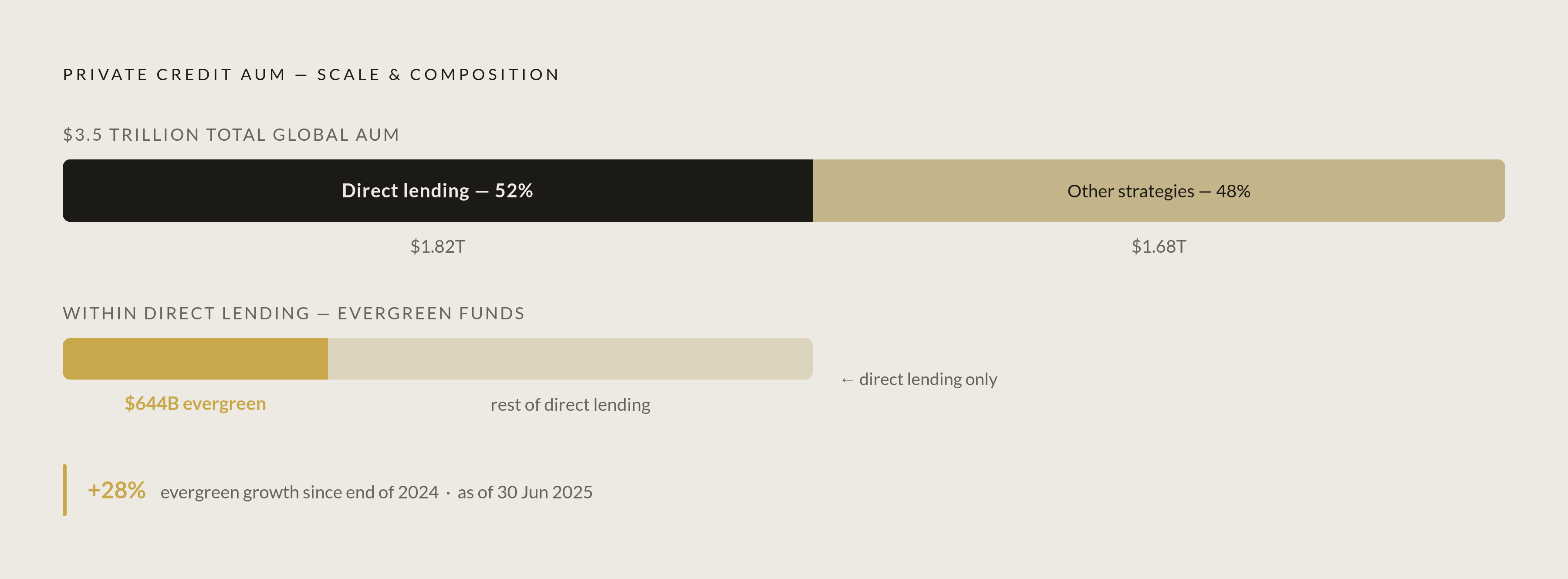
Global private credit assets under management hit $3.5 trillion, and capital deployment climbed to $592.8 billion in 2024, up 78% from the year before. Direct lending drives most of that growth: it now accounts for 52% of global private credit AUM and close to 60% of total private debt raised last year. Most funds still pick loan management software the way they'd pick an accounting package, comparing price and screenshots. That approach is backwards: comparing price and screenshots misses what actually differentiates these platforms. The loan structures direct lenders actually run on break generic infrastructure in specific, predictable ways, and the fix isn't a better spreadsheet, it's picking from a narrow set of platforms actually built for credit.
U.S. direct lending fund assets reached $900 billion, double the figure from five years earlier. Evergreen vehicles, which take in and deploy capital continuously instead of through periodic closings, have added a new layer of strain on top of that: assets in evergreen private credit funds hit $644 billion as of June 30, 2025, up 28% since the end of 2024 and roughly 45% year over year. A fund running that kind of continuous deployment can't lean on batch processes or month-end catch-up work. Capital moves every day, so the system tracking it has to run every day too, not just at quarter-end.
Where direct lending's loan structures break most LMS platforms
A typical direct lending portfolio holds somewhere between 30 and 100 individual loans, and each one carries its own documentation, its own reporting cycle, and its own covenant package. That's a fundamentally different animal than what a public equity manager or a consumer lender deals with, and software built for those users falls short here for a simple reason: it was never asked to solve this problem.
Credit accounting is event-driven in a way equity accounting just isn't. A private equity or venture fund can run on model-driven, periodic valuations, updating a mark once a quarter and calling it done. Credit doesn't work that way. Every payment, every amendment, every PIK election, every covenant test has to get captured the moment it happens, not reconstructed later from a spreadsheet someone forgot to update.
A loan book also carries structural weight an equity book doesn't, including covenant packages, facility structures, internal ratings, a watchlist, and a maturity wall somebody has to watch constantly. Most of these loans are floating-rate, priced as a spread over SOFR, so the general ledger has to track a blended, shifting rate on every position, plus whatever repayment quirks that particular loan carries. Unitranche loans, for instance, are increasingly clustering in a narrow spread range over the reference rate, and that pricing pattern alone complicates day-to-day accounting and the distribution waterfall math sitting downstream of it.
The operational criteria that separate an adequate LMS from the right one
Covenant monitoring is the first real test, and it's the one funds most often get wrong by treating it as a reporting feature instead of an early-warning system. A platform has to support ongoing testing of financial covenants (interest coverage ratio, minimum EBITDA, leverage ratios) and flag problems before they become breaches, not after. A missed covenant test can trigger a default outright, so an alert that appears after the test has already failed functions as a postmortem rather than a warning. The platform chosen also needs to match loan market documentation conventions correctly, LSTA conventions for U.S. positions, LMA conventions for European positions, down to day-count conventions, reference rate mechanics, and how amendments and consents get processed at the position level.
Waterfall and distribution math is the second test, and probably the one with the least room for error. Senior and junior tranche structures, plus managed middle-market loan structures, need waterfall calculations and borrowing base compliance that run without someone manually checking the output every time. Errors here don't stay small. Errors compound as the portfolio scales, and they undermine fund manager and investor trust at the exact moment checks are going out the door.
Full lifecycle coverage, from origination through payoff, is the third test. Everything after the loan closes, amortization schedules, payment processing, delinquency tracking, collections workflows, compliance reporting, portfolio analytics, has to live somewhere, and heading into 2026 the operational case for origination and servicing running on the same system, or connecting without friction, has become increasingly difficult to ignore. Splitting origination and servicing across two vendors causes product rules to stop carrying over cleanly. Schedules get rebuilt by hand. Allocation logic resets. Exceptions start piling up from day one, before the loan has even had a chance to season.
Real-time reporting closes the list. If pulling a delinquency trend or a vintage report means filing a ticket with the data team, portfolio leadership is flying half-blind. Watchlist status, maturity wall exposure, and PIK toggle activity all need to show up on their own, without anyone having to ask. Heading into 2026, that's the baseline; differentiation has to come from somewhere else.
The platform categories available and what each is built for
The private credit software market spans distinct purchase categories that funds routinely conflate, and treating them as interchangeable is a common evaluation mistake. Borrower-level tools handle financial spreading, covenant testing, and early warning signals. System-of-record platforms hold the loan book itself: positions, cash flows, accounting, LP reporting. Data extraction and aggregation tools pull clean, structured information out of raw documents and outside data sources, feeding usable data to both the borrower-level tools and the system-of-record platforms so those layers can function.
Private credit-native platforms, with names like Allvue and Oxane Partners prominent among them, get built around the specific data model a credit fund actually runs on: covenant packages, watchlists, facility structures, LP reporting, native to the system rather than bolted on after the fact. For a direct lending fund, this is usually the right starting point, and skipping straight to a cross-asset platform because it's already in use for the equity book is a shortcut that warrants careful scrutiny before committing.
Cross-asset platforms such as iLEVEL and Chronograph hold credit alongside equity in a single system, which suits multi-strategy managers well but often takes more configuration to handle credit-specific data structures properly. Data extraction and aggregation layers, Canoe, Accelex, Daloopa among them, are not systems of record. They feed the primary platform. They matter for the integration and data quality conversation, but they don't belong in the core LMS decision.
What the leading private credit-native platforms do well
Allvue Systems builds for alternative investment managers broadly, with dedicated solutions for alternative credit strategies, including direct lending and CLOs, alongside private equity, venture capital, and fund administration. The platform is designed to cover deal flow tracking, portfolio monitoring, reporting, and investor communications within a single system. The platform centralizes loan data and layers an AI assistant on top to support workflows and navigation across the book. The Investment Accounting module automates notice processing and cash reconciliation, work that otherwise eats analyst hours and quietly caps how fast a fund can scale. Allvue also packages portfolio management, research, and accounting bundled specifically for private debt managers under a certain AUM threshold, plus an AI knowledge assistant called Andi, delivered as a browser extension, that supports waterfall calculations, research workflows, and portfolio setup inside Allvue's Credit Front Office products. For a direct lending fund that wants one system of record spanning the full loan lifecycle and LP reporting, Allvue's breadth of purpose-built modules makes it a strong candidate to evaluate.
Oxane Partners, through its Oxane Panorama platform, is built for data management, risk monitoring, and reporting across private credit positions. Oxane Panorama's focus on data management and risk monitoring speaks directly to valuation governance, providing visibility into the exposures and portfolio movements behind each mark, which matters most when a valuation needs to hold up under stressed market conditions and outside scrutiny. Oxane has also run a survey of more than 380 senior credit leaders focused exclusively on credit markets, a signal of how deeply the firm sits inside the space it serves. It fits best where valuation governance is a specific pain point, given how directly Oxane Panorama targets that layer of the private credit workflow.
CardoAI is a productized asset-based finance platform with solid data aggregation and portfolio monitoring, and it extends into structured credit and securitization coverage, useful for funds carrying CLO or ABS exposure alongside a core direct lending book. Funds with that kind of structured credit complexity belong on CardoAI's shortlist; funds without it probably don't need the extra surface area.
Lumonic focuses squarely on covenant monitoring and the early-warning compliance workflow. Daloopa, Canoe Intelligence, and Accelex work as data extraction layers feeding portfolio platforms, forming their own category of specialists even though they aren't the core system. Lumonic focuses squarely on covenant monitoring and the early-warning compliance workflow. Daloopa, Canoe Intelligence, and Accelex work as data extraction layers feeding covenant and portfolio platforms (Daloopa also does financial spreading), and while none of them are systems of record, the data quality they produce upstream determines how much a fund can trust the numbers downstream. Document AI tools, Kira, Luminance, Harvey, and Legora among them, pull covenant terms straight out of loan documentation at origination, cutting down the manual rekeying that's often where errors first creep into the system. Moody's Lending Suite offers an end-to-end origination solution with a built-in covenant management module, a natural fit for funds already running on Moody's analytics and data infrastructure.
Structuring the vendor evaluation process once the shortlist is set
Start with the actual failure mode as the basis for the decision, rather than working from a feature checklist. Figure out where the current drag really sits, covenant monitoring, LP reporting, the origination-to-servicing handoff, valuation governance, or plain scaling capacity, and let that answer anchor the whole evaluation. A platform that's excellent at LP reporting doesn't help much if the real problem is covenant breaches slipping through unnoticed.
Map the integration requirements before a single demo happens. Know what sits upstream (the origination system, document AI tools, data extraction) and what sits downstream (fund accounting, the LP portal, audit), and make vendors show live integrations, not roadmap slides. Confirm, in the room, that product rules, schedules, and allocation logic actually transfer without anyone rebuilding them by hand, because defects appear most often in the origination-to-servicing handoff.
Then test covenant monitoring against real portfolio complexity. Run an actual covenant package through the platform, interest coverage ratio, minimum EBITDA, leverage ratio, and confirm that early-warning alerts fire before a breach occurs, not after. If the portfolio spans multiple loan markets. and European positions, check that the platform's amendment and consent mechanics actually line up with LSTA and LMA conventions respectively, matching each market's specific rules rather than a generic approximation of both.
Finally, stress-test the waterfall and distribution math directly. Hand the vendor a senior/junior tranche scenario and require the platform to produce the calculation without manual intervention anywhere in the process. A platform that still needs a side spreadsheet to get the waterfall right isn't built for a portfolio scaling the way direct lending is scaling right now, and that gap alone should end the conversation.